Social networks
Overview -
"Birds of a feather flock together" - due to the presence of a tendency called homophily as investigated by Paul Lazarsfeld (the founder of modern empirical sociology, people with similar habit or characteristics form groups together. The homophiliy may arise from two fundamental kinds of similarity - (a)'Similar status' - may be an ascribed status such as caste, gender, ethnicity or may be 'Acquired status' such as educational qualification, occupation etc., Or (b) 'Similar attitude', ability, belief etc. The same behavior of humans gets reflected in online world also. On the other hand, due to a kind of heterophiliy (i.e., love for the others) and also pluralistic homophiliy people often participate in multiple social groups. Thus, different groups generally have many people in common. This common members play crucial role in the trnsmission of information from one group to the other. As a step towards understanding the dynamics of the information dissemination in the system, we do a through structural analysis of the intergroup network where the nodes represent the groups and the weight of an edge between two groups is the number of common members among the groups.
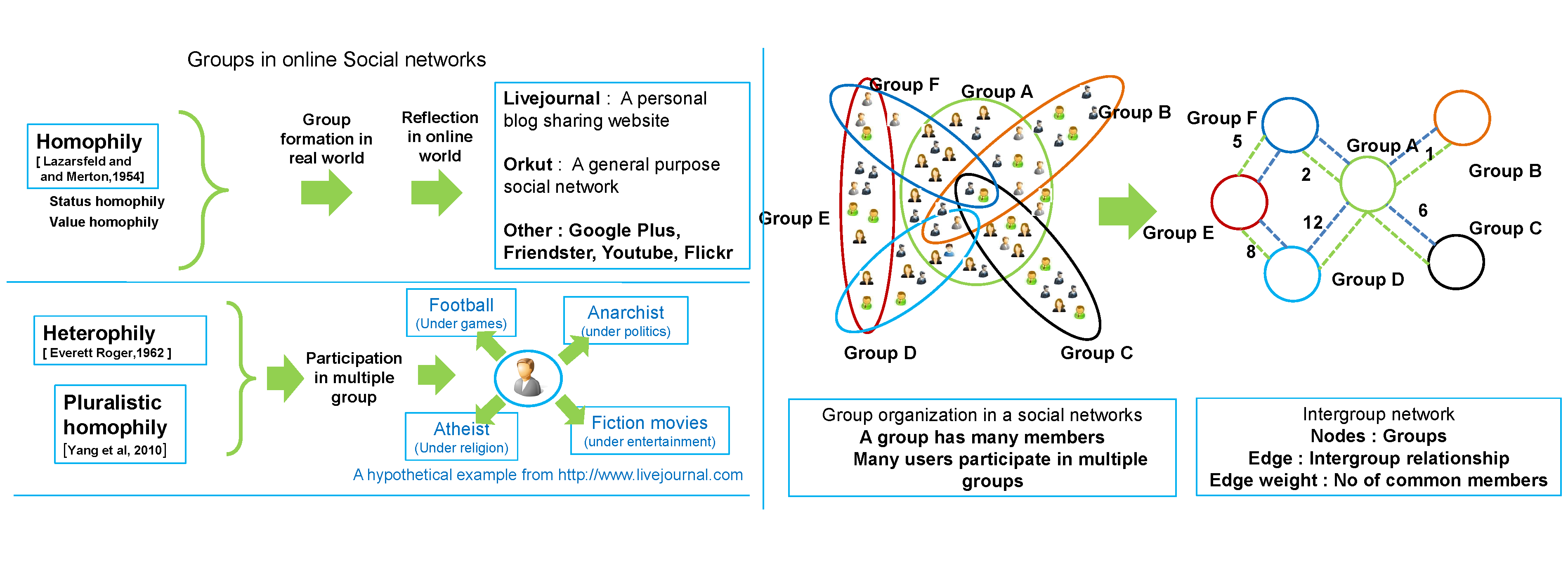
We study this intergroup network using two mathematical models. In the work published in Journal of Selected Areas of Communication, 2013 [1], we use a special kind of bipartite network, known as Alphabetic Bipartite Network to study the evolution of the intergroup network. In the other work [2] we employ a more basic graph theoretic model called - 'random threshold graph'. The manuscript has been communicated to Physical Review E.
Publication -
[1] Understanding evolution of inter-group relationships using bipartite networks. Saptarshi Ghosh, Sudipta Saha, Ajitesh Srivastava, Tyll Kuerger, Niloy Ganguly and Animesh Mukherjee. IEEE Journal on Selected Areas in Communications, Special Issue on Emerging Technologies in Communications, 31(8), 1-11, 2013.
Manuscript under review -
[2] Intergroup networks and random threshold graphs. Sudipta Saha, Tyll Kuerger, Animesh Mukherjee and Niloy Ganguly. communicated to Physical Review E.