Bipartite networks
Overview -
Several real life scenarios can be well captured by a Bipartite Network. For example, in a social context, the friendship among different people may evolve because of studying in same school, college or having similar habits etc. Thus, the relationships among persons may evolve depending on these commonalities in their social life. Even, in various other fields also we can easily identify two distinct types of entities - where the relationship between the entities of a particular type evolves based on their interactions with the entities of the other type. We identify a special class of such bipartite systems: where the cardinality of one partition remains fixed over time while the same of the other partition increases proportional to time. We call such systems as `Alphabetic bipartite networks'. We study several issues regarding the evolution of such bipartite networks as described below.
The interaction of the two partitions in alphabetic bipartite networks depends on the strategy followed by the members of the active partition (growing) to select and attach with members of the passive partition (fixed). We study the effect of different types of such attachment strategies - such as connection with replacement or without replacement, parallel etc. This work [1] has been published in European Physical Journal B (EPJB).
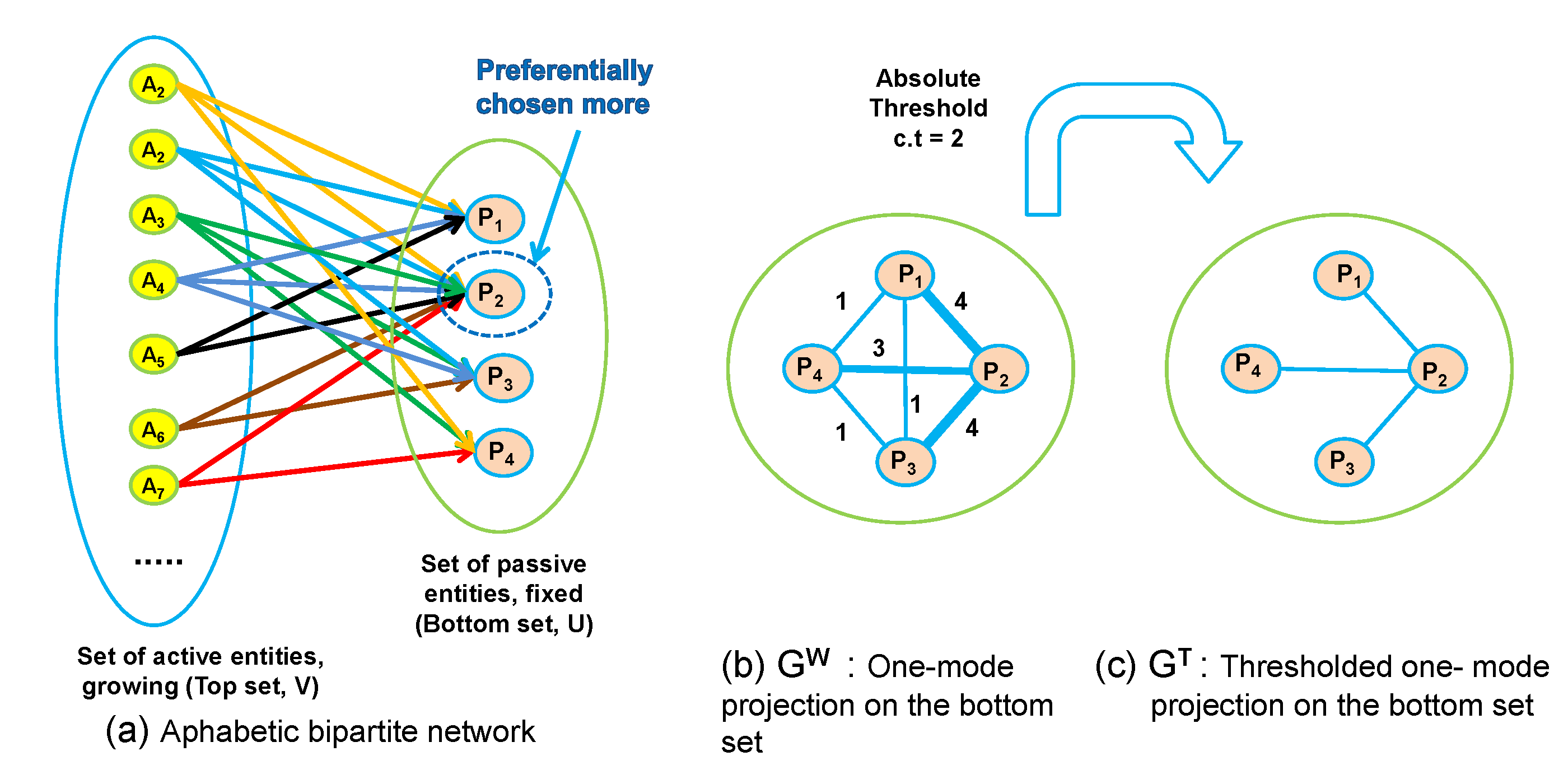
Furthermore, we are doing a detailed structural analysis of the one-mode projection of an asymptotically grown alphabetic bipartite network with large number of active as well as large number of passive entities. We map the thresholded one-mode projection of a preferentially grown alphabetic bipartite network to another graph theoretic concept called random threshold graph. Ultimately, we could derive a basic mathematical framework which can be exploited to analyze any structural property of such systems.
List of publications -
[1] Effect of attachment strategies on bipartite networks, Niloy Ganguly, Sudipta Saha, Abyananda Maity, Sachin Agarwal, Fernando Peruani and Animesh Mukherjee, European Physical Journal B., 86, 287, 2013 [Online]